
By Jordan Jantz
At a recent roundtable, a senior White House official posited that eliminating fraud could balance the federal budget. With billions of dollars reportedly taken from taxpaying Americans going to fraudsters, it’s no wonder that the topic is breaking headlines with new egregious examples emerging each week. But among these astronomical numbers, it’s easy to get wrapped up in the outrage and lose sight of who fraud affects the most: ordinary Americans.
Fraud by the Numbers
“If you buy groceries or health insurance or a number of other things, welfare growth and welfare fraud does affect you,” said Paige Terryberry, a Senior Research Fellow at the Foundation for Government Accountability who studies how fraud impacts everyday Americans.

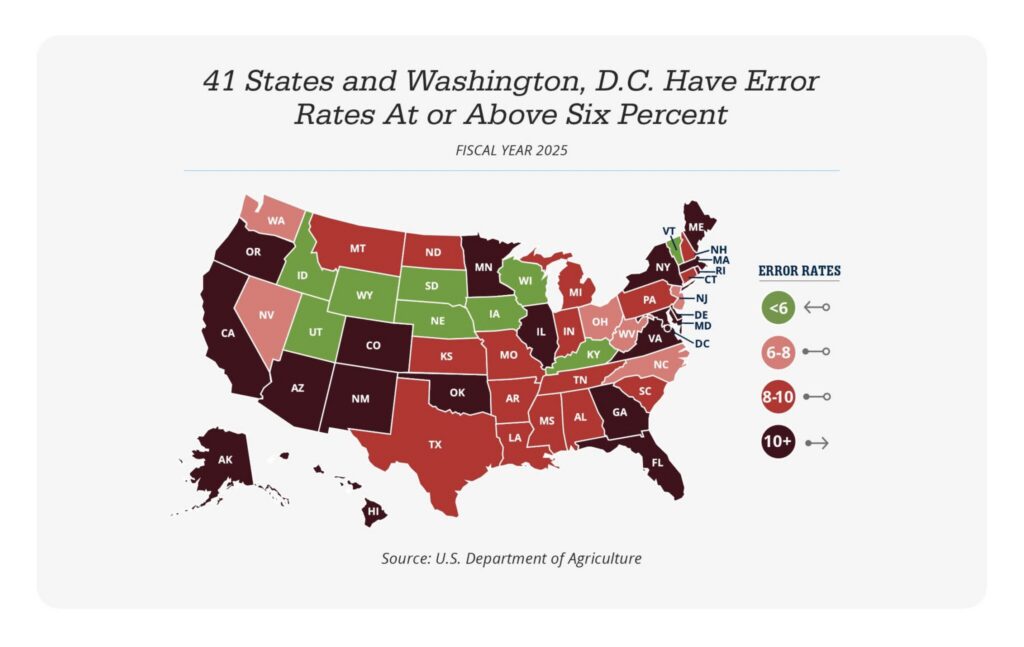
Consider going to the grocery store and seeing the prices have jumped again. While there are plenty of reasons behind cost increases, such as supply chain problems, one unseen reason is food stamp fraud. According to Terryberry, food prices go up 1% for every 12.5% in food stamp spending, and when fraudsters game the system to sign up for food stamps, spending increases and so do grocery prices. She added that more than $1 in $10 in food stamp spending is paid out in error; in just one year, this amounts to $10.5 billion. The fraud rate is even higher for Medicaid, with more than $1 in $5 paid in error.
Fraud by Design
With programs like food stamps and Medicaid being abused by fraudsters, those funds are being taken from their intended recipients who may truly need assistance to get through hard times and instead spent by people who have ample financial means, according to Terryberry.
For example, she pointed to headlines reporting that Ferrari owners and millionaires are receiving food stamps. While food stamps do have income requirements, individuals who qualify for certain other welfare programs can bypass those income requirements and become automatically eligible. Forty-three states use this loophole. It’s called broad-based categorical eligibility, and households receiving food stamps through these means are responsible for 82% of food stamp payment errors, Terryberry said.
Reforming the System
Fortunately, as fraud is becoming a mainstream topic, there are already new avenues in place to eliminate the abuse. Terryberry said that the One Big Beautiful Bill (OBBB) Act created accountability for states to eliminate fraud and mismanagement. Previously, states had little incentive to ensure welfare recipients actually met eligibility requirements, she said. This means that states have deceased people on Medicaid rolls and that individuals are able to receive welfare benefits twice over by enrolling in multiple states. Now, states have accountability checks and deadlines, and states not meeting these standards have to pay for benefits out of their own pockets—rather than Americans’ federal tax dollars paying for this fraud.
“The state now has skin in the game to make sure that those programs are being run smoothly and that the truly needy are the ones who are receiving those benefits,” she said.
Work requirements are another standard that Terryberry pointed to in the OBBB. Rather than encouraging a system of dependency where individuals can stay on welfare for extended periods of time and not seek employment, the OBBB requires able-bodied Americans to work to retain benefits, hopefully eventually freeing them from government assistance.
The Real Victims
For hard-working Americans trying to make ends meet each week, living on a budget, and scanning grocery prices, ending the rampant fraud would be a break for wallets. For the federal budget, ending fraud would mean cutting billions of dollars in frivolous spending—and saving taxpayers billions of dollars. And for Americans who truly need assistance, ending fraud would ensure they receive the help and funding promised to them.
“Welfare fraud is not abstract, and it’s not a victimless crime,” Terryberry concluded.

ABOUT THE AUTHOR
Jordan Jantz is a freelance writer, editor, and website designer as well as the assistant editor at IW Features. Her work has spanned the nonprofit, small business, and scholarly worlds, but most of all, she is passionate about uplifting the message of hope and freedom. Find her at jantzwriting.com.