By Jamie Oleka
A conversation about his new book, Good Money, and why the path to financial freedom starts with what you believe
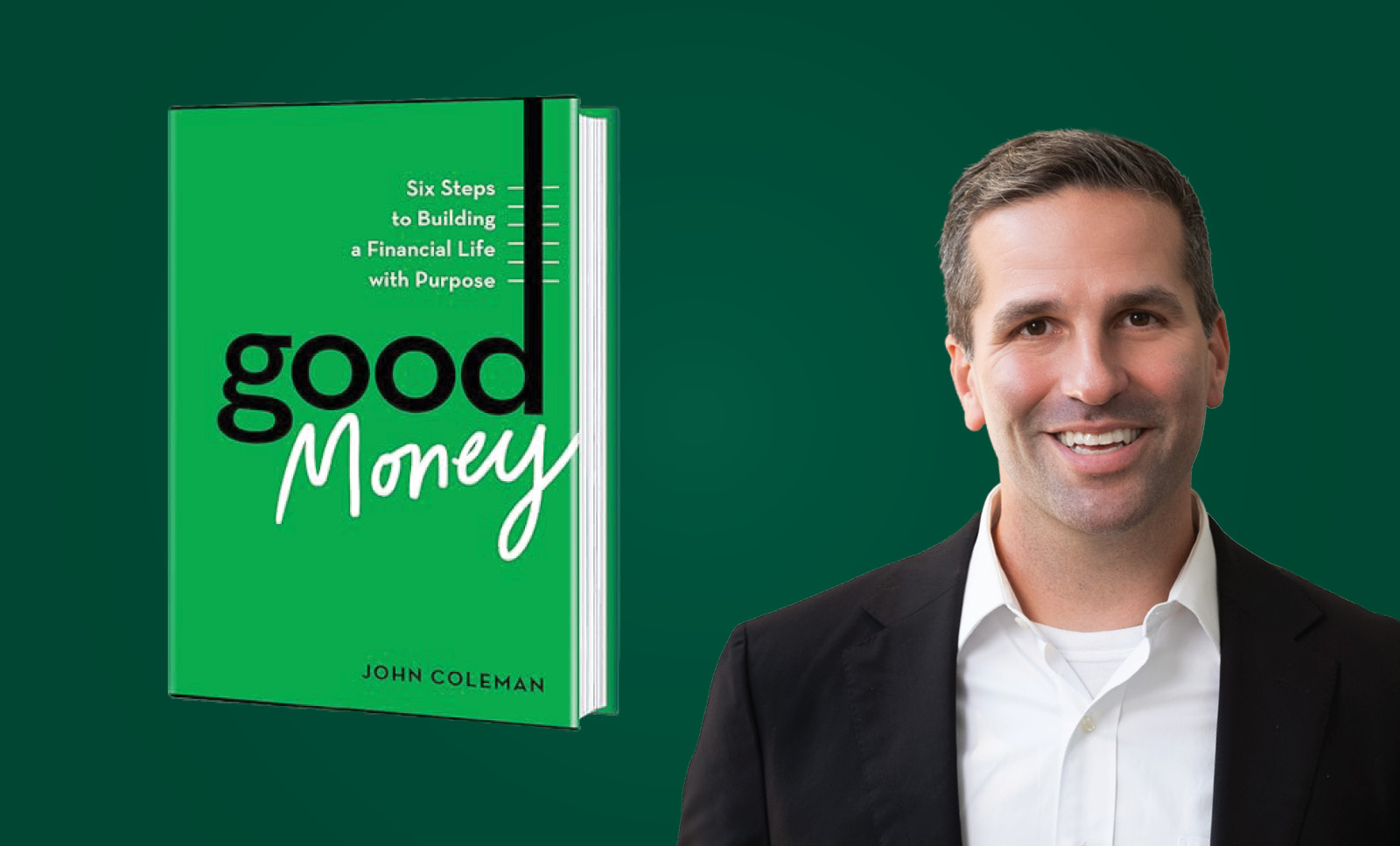
Most financial advice starts with a spreadsheet. John Coleman thinks it should start with a mirror. His new book, Good Money, published by Harvard Business Review Press, is the first HBR title to tackle personal finance. It does so not through budgets and stock tips, but through a six-part framework for financial flourishing: develop good money mindsets, earn with purpose, consume wisely, give generously, invest for impact, and save for freedom. For women navigating career ambition, family life, and the cultural pressure to have more, Coleman’s message is both refreshing and urgent: the good life is not the expensive life.

Develop Good Money Mindsets
At the heart of Good Money is an idea that sounds simple but runs counter to nearly everything our culture tells us: set a financial finish line. Coleman argues that without a deliberate decision about what “enough” looks like, we fall prey to hedonic adaptation, the psychological tendency to always want more. We buy more, feel briefly satisfied, then chase the next purchase. The cycle leaves us exhausted and no closer to fulfillment. Developing a good money mindset, the foundation of Coleman’s entire framework, means breaking that cycle before you ever open a budget spreadsheet.
Coleman urges readers to separate their worth from their net worth. By anchoring your view of money to what he calls “human flourishing”, a life rich in purpose, connection, and meaning—you create a framework where financial decisions serve your deepest values instead of undermining them. He draws on ancient wisdom from Christian and Jewish traditions and modern scientific research, weaving together a case that is both rigorous and personally convicting.
Earning with Purpose
For women weighing career moves, motherhood, or a midlife pivot, Coleman’s chapter on purposeful earning hits home. He cites a sobering statistic: only seventeen percent of Americans report finding genuine significance in their work. His advice is direct, don’t settle for a paycheck without purpose. Reflect on what gives you meaning, have honest conversations with your partner about shared goals, and conduct regular check-ins to ask whether your career still aligns with your values. Purpose, Coleman says, is not only something you find; it is something you build by focusing on your craft, connecting your work to service, and cultivating positive relationships.
Consume Wisely
Coleman challenges readers to examine whether their spending reflects their deepest convictions or merely their impulses. Consuming wisely, he argues, is not about deprivation, it is about alignment. He recommends intentional steps: when you make a life change—a new job, a move, a growing family —pause and list everything that gives you meaning. Then compare that list to where your money actually goes. The gap between the two is where transformation begins. Wise consumption means choosing experiences and purchases that move us toward flourishing, not just fleeting satisfaction.
The Power of Generosity
Perhaps the most compelling thread in Good Money is Coleman’s case for radical generosity. He points to research showing that generous people experience better physical and psychological outcomes, and even studies of toddlers suggesting that a desire to serve others is intrinsic to our nature. Yet Americans give away less than 2% of GDP, and 4 in 10 give away nothing at all. Coleman calls readers to move from occasional generosity to strategic, intentional impact. In his own family, he practices what he preaches; each of his children has a giving ledger and a discretionary account, learning firsthand how smart stewardship multiplies the ability to give.
Save for Freedom, Not Retirement
One of Coleman’s most provocative ideas is a reframe of the retirement narrative. Rather than working for decades just to stop working, he advocates saving for freedom—building enough of a financial buffer to pursue the most meaningful work of your life at any stage. Staying engaged throughout life is linked to slower mental decline and greater well-being. The goal is not to stop contributing; it is to contribute on your own terms.
Raising the Next Generation
For mothers reading this, Coleman’s advice on raising financially wise children may be the most valuable takeaway. Start early, he says. Tie a family’s mission, vision, and values to concrete money practices, teaching kids to be prudent, to save, and to give. Let children choose charities, match their contributions, and give them real responsibility with real accounts. These are the building blocks of a purpose-driven financial life.
Good Money is not another book telling women to cut lattes and max out their 401(k) s. It is an invitation to reconsider what money is actually for, and to build a financial life that reflects not just where you want to go, but who you want to become.

ABOUT THE AUTHOR
Jamie Oleka, a wife, mom, and a passionate advocate for debt free quality education, has extensive experience in K-12 and nonprofit management having most recently served as a Managing Director at Teach For America. Jamie holds a Masters of Education in Instructional Accommodations from Francis Marion University, Masters of Arts in Teaching, and Ed.S. in K-12 Administration from the University of Louisville.