By Jordan Jantz
While the modern American woman might be found in the office, at home, and everywhere in between, life in America has changed drastically over its 250-year history. The modern American woman may be defined by her job, family, or community, but she is also defined by the women who came before her.
As we celebrate America’s 250th year of nationhood, it’s only fitting to reflect on the generations of women who helped form America as we know it today. What was life like for American women over the decades and centuries? Who was the American woman of yesteryear?

This is Being an American Woman, from the birth of America to the turn of the 20th century.
A New Beginning: Women in Early America
In the early years of America, women and families arrived with little to nothing to start their lives. It was up to women to help their families survive—and, along the way, to build up a nation for future generations.
Survival in the American colonies was challenging, and female fertility was an important aspect to the continual survival of communities, as was finding ways to adapt to life in the new world. America’s first cookbook demonstrated just one way that women had to adapt to a new continent, with recipes that prepared new-world ingredients like cornmeal and potatoes using old-world cooking methods.
America was not yet formally a nation, and women had yet to play their role in the Revolutionary War. In the fight for America’s independence, married women often followed their husbands in the Continental Army. They supported men on the campaigns, caring for wounded and sick soldiers. As the American government was being formed, influential women advocated for women’s place in the new nation. As Abigail Adams wrote to her husband, John Adams, “If particular care and attention is not paid to the ladies, we are determined to foment a rebellion, and will not hold ourselves bound by any laws in which we have no voice or representation.”
While women did not yet have the same legal status as men, it didn’t stop them from playing a powerful role in shaping American society—or from having important rights recognized in American law. America also made strides toward recognizing women’s rights by prioritizing women’s safety by prosecuting sexual crimes, and equal rights were already being discussed in important circles.
Aside from the important task of raising the next generation of Americans, free women were the primary economic drivers of the American household, buying most items that homes needed day-to-day. And the seeds of the modern American woman’s life were already present: women formed female-only schools, worked in certain jobs like at cotton mills, and ensured the spiritual fomentation of the nation.
Women on the Frontier and Civil War
As America expanded westward in the mid-1800s, women helped their families build better lives, settle land, and seek new opportunities beyond the Mississippi. Like the early colonization of America, the trip was dangerous, and women had to find new ways to make ends meet without the support or comforts of home.
However, life looked much different for enslaved women in America, and change was brewing with the Civil War. Similarly to the Revolutionary War, many women supported their soldier husbands by holding down the home or tending to soldiers in need of medical attention—this time as nurses, solidifying nursing as a female profession. For black women, Reconstruction was a new era. Creating a new life—especially in the fallout of a war, and during a time when discrimination was common—meant finding ways to earn money, support a family, and reunite with loved ones separated during slavery.
Industrialization and Changing Roles
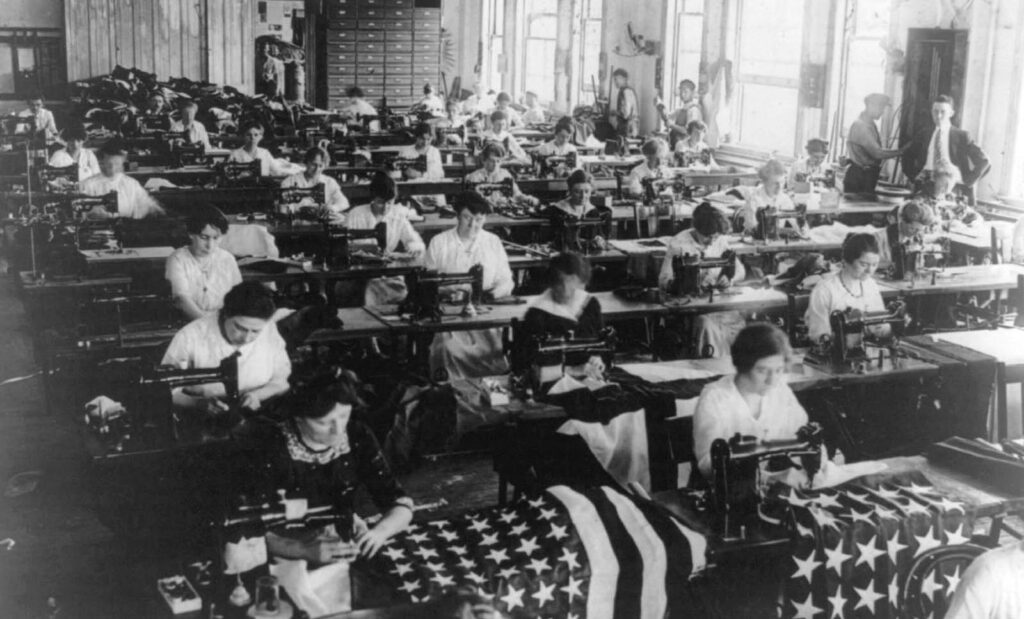
And more change was soon to come for women of all ethnicities in America with the Industrial Revolution. While the workforce transformed around mechanization, the home also transformed. Suddenly, time-consuming menial tasks had machines to assist homemakers. Those who could afford these gadgets became part of an expanding middle class targeted with consumerism and advertisements.
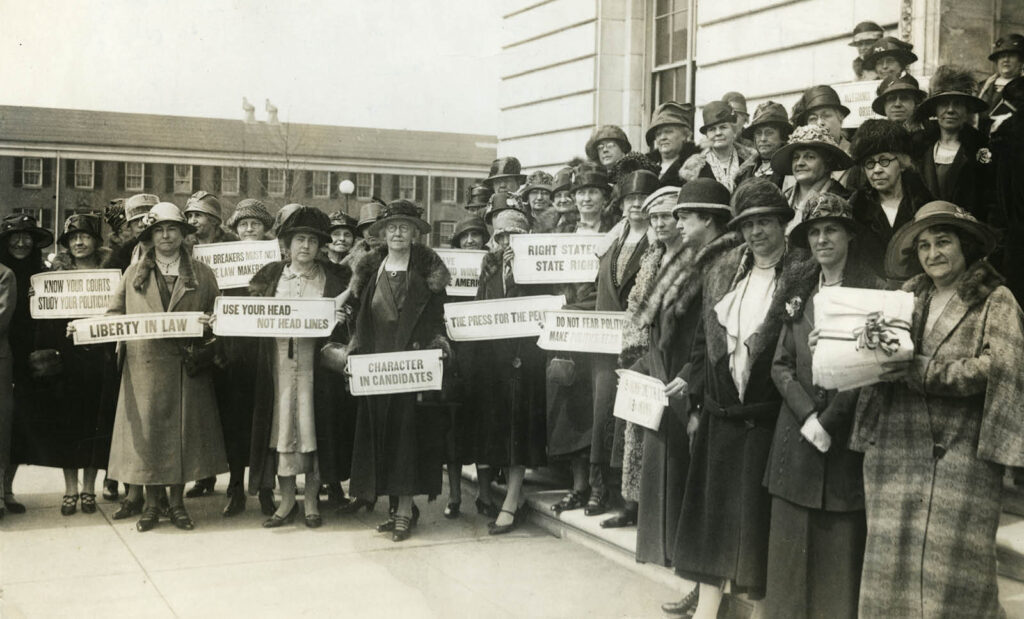
As life for Americans radically shifted, social norms for women also changed. Women during this time were active politically, driving the temperance movement and prohibition, campaigning on the harms of excess drinking to families. Many women also began working outside the home—some were even encouraged to do so—though the type of work available to women remained limited.
This soon changed with World War I. As men were drafted into the war, women were left to hold down the homefront. Out of necessity, more workforce opportunities opened as women filled the jobs in factories and munitions plants that men left behind. Some women even served in the armed forces, as nurses, but now also as mechanics, cryptographers, truck drivers, switchboard operators dubbed “Hello Girls,” and more. In total, approximately 16,500 women served overseas in Europe. Women’s role in World War I also ignited the conversation around women’s suffrage, already spurred on by the 15th Amendment, which granted black men the right to vote. While women were divided on whether the right to vote was one they wanted, a state-based approach and growing national attention tipped the scales to ratify the 19th Amendment in 1920.
Of course, industrialization did not improve everyone’s lives: many Americans couldn’t afford these new technologies, factory working conditions were often dangerous, and new waves of immigration upset the economy. Needless to say, the shift from an agrarian society to an industrial one was not without its growing pains.
The post–World War I economy brought on a brief boom era—the Jazz Era—where women exercised greater cultural and economic influence, the “new” liberated woman became a stereotype, and women sought greater educational opportunities. But soon, the boom became a bust with the Great Depression. Like the early American settlers, women had to find creative ways to make ends meet and stretch everything to feed the family, this time in a modern era.
Shaping a Nation
This was America in its first dozen decades. Life was never easy, it wasn’t luxurious or guaranteed, and it did not offer equal rights to everyone. But it held the promise of freedom, prosperity, and equality to come.
Of course, each American woman’s story is unique, and no historical summary can completely capture the lived experience of thousands. Still, for many American women, these were the defining features of their time. From the frontier to the factory, from the hearth to the home front, American women shaped the nation.

ABOUT THE AUTHOR
Jordan Jantz is a freelance writer, editor, and website designer as well as the assistant editor at IW Features. Her work has spanned the nonprofit, small business, and scholarly worlds, but most of all, she is passionate about uplifting the message of hope and freedom. Find her at jantzwriting.com.