By Carrie Sheffield
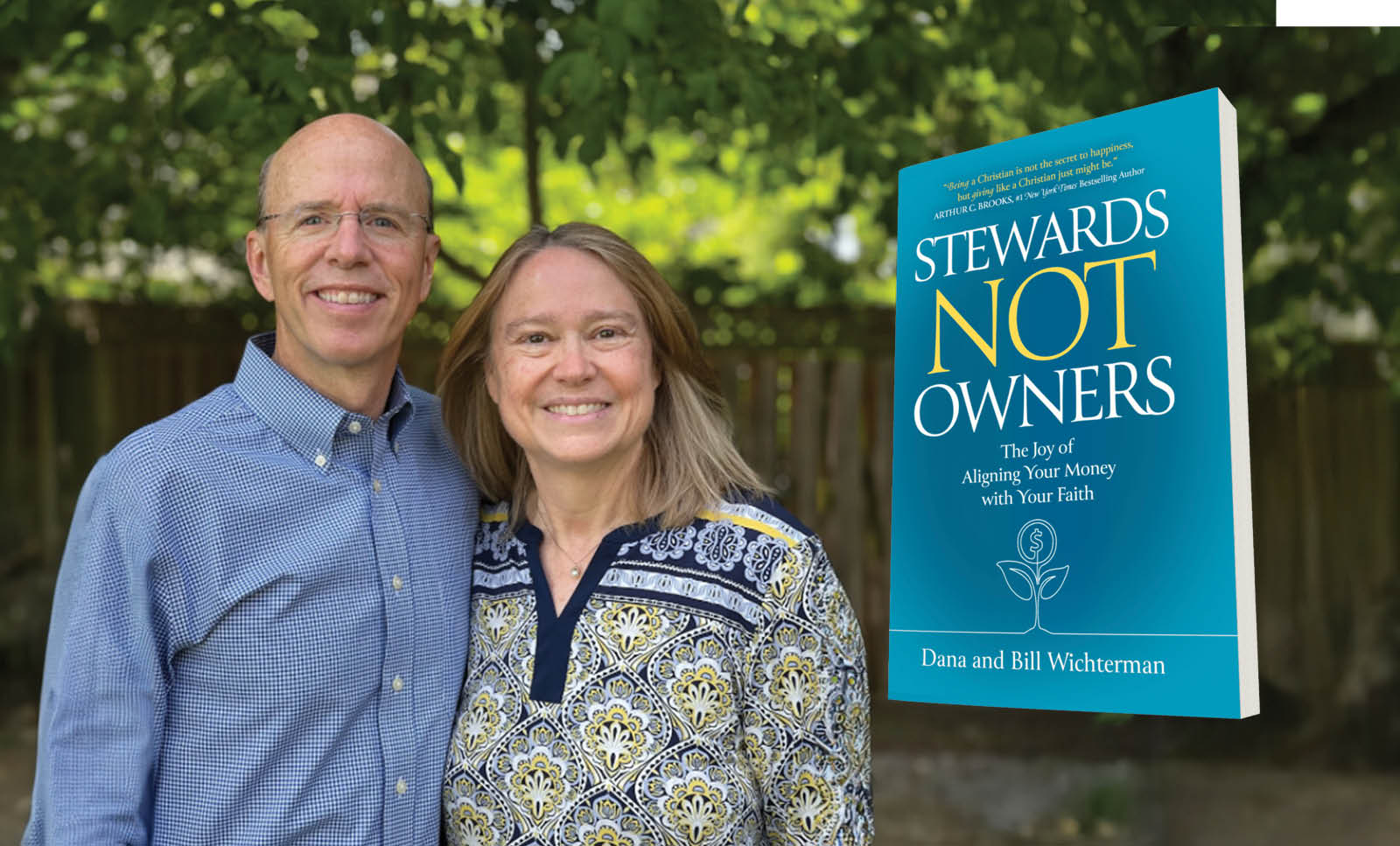
Christian philanthropists Dana and Bill Wichterman, authors of the new book Stewards, Not Owners: The Joy of Aligning Your Money with Your Faith, created a handbook on how to view wealth through a balanced, humble yet empowered lens.
The Wichtermans discuss how money can be a source of anxiety, idolatry, or blessing—and how to cultivate a “healthy faith” approach to wealth that honors God while promoting mental and spiritual well-being.

Stewards Not Owners expands the traditional Christian concept of tithing—giving 10% of monetary income—to encompass a new paradigm: that everything—our time, talents, treasures, relationships—belongs to God. And they are ours for us to steward carefully while on earth with joy and creativity.
Rather than focusing on simply giving away 10 percent of their income, Dana and Bill challenge readers to activate 100 percent of their wealth and wealth-creating potential for kingdom goals.
“Living generously is the best way we have discovered to dethrone money in our lives,” the Wichtermans write. “Generosity has a way of uncoiling the serpent of money from around our hearts.”
Stewards Not Owners is a powerful guide for living a life of generosity in both spirit and financial resources. The Wichtermans know of what they speak. Dana’s late father made numerous investments over his life, many of which failed. But years after his death, one significant investment panned out, leaving Dana with a large inheritance that proved at first overwhelming and stressful for her.
She and Bill married with almost no money, and the young couple worked in modestly paying government roles. It took time for Dana to see the fortune as a blessing to be used to honor God and serve others.
“Money is a dangerous blessing. It can lead us to be greedy, lazy, addicted to luxuries, arrogant, and exploitative,” the Wichtermans write. “Regular self-examination of how we use money is critical to becoming good stewards.”
Dana previously worked for USAID, the government agency managing billions of dollars in aid from the U.S. federal government to developing nations. The Wichtermans share in their book how they realized with time the power of investment and for-profit enterprise as the more sustainable paths (vs. perpetual charity/handouts/dependency) toward the human dignity of work and breaking generational poverty.
Tapping into their diverse network of friends from around the globe, Dana and Bill highlight the inspiring stories of 24 individuals who embody a lifestyle of radical stewardship. Many of them work in international impact investing–working to create systems where impoverished people lift themselves out of poverty by creating their own thriving businesses rather than remaining trapped in a perpetual cycle of dependency on handouts.
“There is no evidence that God wanted us to lead a subsistence life, which is a life almost wholly devoid of profit,” the Wichtermans write. “To the contrary, the biblical ideal is prospering cities and farms with feast times and bountiful harvests. None of this can happen without profit.”
They quote from Patrick Fisher, a successful asset manager and founder of Creation Investments Capital Management, a private equity firm with $2.2 billion in assets under management and $15 billion in loans outstanding, mostly to low income women in the developing world who would otherwise be rejected by establishment banks.
“Larger, systemic charity tends to lead to bureaucracy and ultimately an exploitative power grab of the very group you’re trying to serve–and a dependency that is bad for the human soul,” Fisher told the Wichtermans in an interview for the book. “We are so skewed in our thinking about capital. Christians clip the wings of so many people who have great business talents, asking them just to make money only so they can give it to the church … We don’t serve low-income people in the developing world because they’re Christians, but because we are.”
The Wichtermans share how to incorporate faith into our financial decisions, including through prayer and having vulnerable, transparent financial accountability conversations with trusted friends. Our society often cloaks financial conversations in secrecy, and this thinking is helpful to ensure that financial decisions are made wisely.
The Bible emphasizes the importance of seeking counsel and advice, particularly from “many counselors.” Proverbs 11:14 says, “Where there is no counsel, the people fall, but in the multitude of counselors there is safety.”
The authors also discuss how faithful Christians could be inadvertently funding companies and initiatives that actively work against biblical values. As a former economic fellow for the State Financial Officers Foundation (SFOF), the parent organization of Smart Women Smart Money magazine, I found this particularly interesting.
SFOF is at the forefront of pushing back against “ESG,” mandates, which stands for Environmental, Social, and Governance. The ESG framework in recent years has been used to evaluate how companies operate under certain criteria that often collide with traditional values and limited-government worldviews. Thanks to the efforts by SFOF and others, ESG is declining in popularity and implementation.
What I loved about reading Stewards Not Owners is the fact that surrendering all our finances to God doesn’t have to mean living a dull, joyless, ascetic life. We can enjoy God’s financial blessings while still using them to expand His kingdom and lead a life of true abundance and eternal significance.
Stewards Not Owners is an inspiring read from a powerful couple who share how we can use our resources wisely to honor God and serve others.
ABOUT THE AUTHOR
Carrie Sheffield is a columnist and broadcaster in Washington, D.C. She earned a master’s in public policy from Harvard University, concentrating in business policy. She earned a B.A. in communications at Brigham Young University and completed a Fulbright fellowship in Berlin. She managed municipal credit risk at Goldman Sachs and rated healthcare bonds at Moody’s Investors Service. Carrie later researched for American Enterprise Institute scholar Edward Conard and served as Warren Brookes Journalism Fellow at Competitive Enterprise Institute. While serving as executive director for Generation Opportunity, a project of Americans For Prosperity, she spoke at the U.S. Senate alongside key senators in favor of landmark tax reforms passed by Congress in 2017.
Carrie is a member of the Harvard Christian Alumni Society, The National Press Club and the Society of Professional Journalists. She is a 2018 winner of the William F. Buckley Awards by America’s Future Foundation, is listed in Maverick PAC’s “Future 40” 2019 class of influential young conservatives and named a Most Inspiring New Yorker by Bumble, a social connection app with more than 55 million global users.
Carrie is also the author of a new memoir, Motorhome Prophecies: A Journey of Healing and Forgiveness.